
Council Approval & Regulations
Building a Concrete Pool in a Mine Subsidence District: A Guide for Lambton Homeowners
You might be picturing a concrete pool in your Lambton backyard, with a deck, a pergola and room for the family to spend summer outdoors. Before design starts, one planning question is worth answering early. When you're building a concrete pool in a mine subsidence district, the guideline assigned to your property shapes what the pool needs and who signs off on it.
Lambton takes its name from the Lambton Colliery, which began operating in 1863. The suburb's coal deposits also supported several smaller workings. Because of that mining history, subsidence is worth raising at the start of local pool planning.
The question goes further than whether your block sits inside a district. It's about what your guideline actually says about the pool, and about the fence, cabana and deck around it.
In this guide, we explain the two families of subsidence guidelines and what each historical-workings guideline says about concrete pools. We cover who can assess or certify your project and how the exempt list treats fences, pergolas, cabanas and decks. We finish with what happens when a design doesn't fit and how to confirm your own guideline.
In this article:
- Does a Concrete Pool Need Subsidence Advisory Approval?
- Lambton's Mining Past and the Two Families of Subsidence Guidelines
- What Each Historical-Workings Guideline Says About Concrete Pools
- Who Signs Off: Subsidence Advisory, Council or a Registered Certifier
- Beyond the Pool Shell: Fences, Pergolas, Cabanas and Decks
- When a Design Doesn't Fit the Guideline, and Confirming Your Own
Does a Concrete Pool Need Subsidence Advisory Approval in a Mine Subsidence District?
If your property is in a declared Mine Subsidence District, yes. Subsidence Advisory NSW states that any construction or alteration in a declared district needs its approval under section 22 of the governing legislation. Any development that isn't explicitly on Subsidence Advisory's exempt developments list also needs its approval. In-ground concrete pools don't appear on that list, based on the April 2023 version. What the pool needs beyond approval depends on which guideline is assigned to your address. For example:
- Under Guidelines 1 and 1A, the concrete pool needs an engineer's certification.
- Under Guidelines 2 and 3, concrete pools are listed as permitted.
- Guidelines are subject to change, so check the current version that applies to your property.
Lambton's Mining Past and the Two Families of Subsidence Guidelines
Lambton's coal-mining story began with the Lambton Colliery and carried on through several smaller workings. For pool planning today, the practical link to that history is Subsidence Advisory NSW's surface development guidelines.
These guidelines fall into two families. Guidelines 1, 1A, 2, 3 and 3A cover historical mine workings. Guidelines 4, 5 and 6 cover current mining areas.
| Guideline family | Guidelines |
|---|---|
| Historical mine workings | 1, 1A, 2, 3, 3A |
| Current mining areas | 4, 5, 6 |
Each property in a Mine Subsidence District is assigned a specific guideline. You can find the guideline for a property through the NSW Planning Portal's ePlanning Spatial Viewer.
This article focuses on the historical-workings family. If a property falls under one of the current-mining guidelines, we explain how the current-mining guidelines affect pool design in Lambton on our Lambton page.
What Each Historical-Workings Guideline Says About Concrete Pools
Within the historical-workings family, each guideline treats a concrete pool a little differently. Some require an engineer's certification. Others list concrete pools as permitted.
| Guideline | Concrete pool treatment | Engineer certification needed? |
|---|---|---|
| Guideline 1 | Pool must remain serviceable if a 5 m pothole forms | Yes (structural engineer) |
| Guideline 1A | Pool must remain serviceable under a 1.5 m pothole and safe under a 3 m pothole | Yes |
| Guideline 2 | Concrete pools permitted, in-ground and above-ground | No pool-specific requirement listed |
| Guideline 3 | Concrete pools permitted, in-ground and above-ground | No pool-specific requirement listed |
| Guideline 3A | Concrete pools permitted, in-ground and above-ground | No pool-specific requirement listed |
Guideline 1
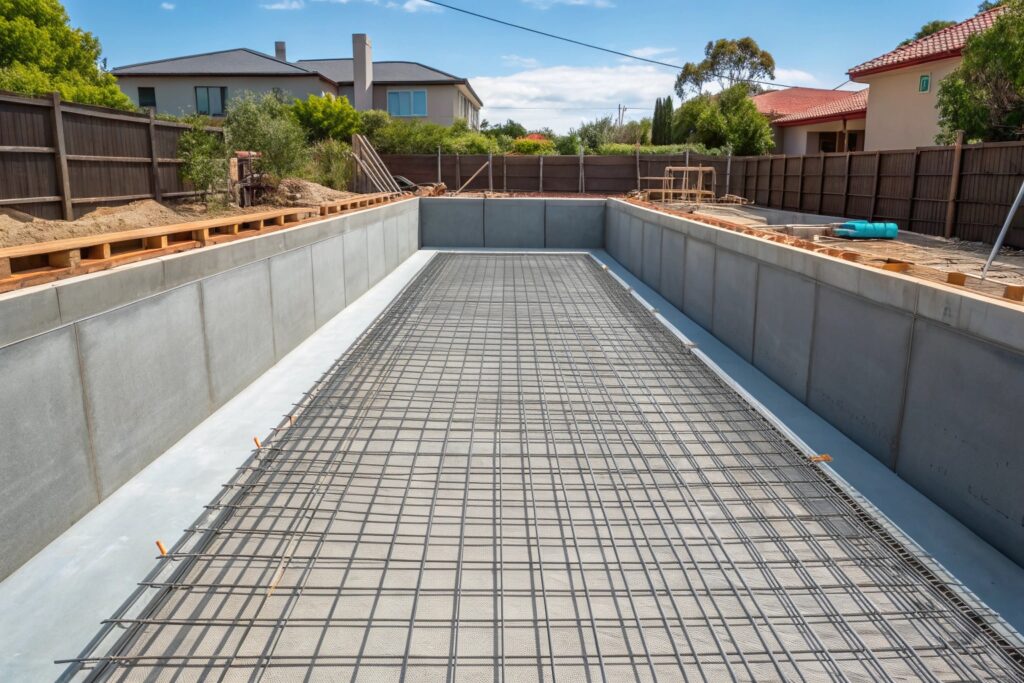
Guideline 1 applies where shallow historical workings carry a high or moderate pothole risk. Under this guideline, a concrete pool needs a structural engineer's certification. The engineer certifies that the pool will remain serviceable if a 5 m pothole forms. The pothole size is the design parameter Subsidence Advisory NSW sets for the pool.
Guideline 1A
Under Guideline 1A, a concrete pool also needs an engineer's certification. The pool must be certified to remain serviceable under a 1.5 m pothole and safe under a 3 m pothole.
If a property has Guideline 1 or 1A, you can read more about designing a concrete pool around site requirements.
Guidelines 2 and 3
Concrete pools, both in-ground and above-ground, are listed as permitted under Guideline 2. Guideline 3 also permits concrete swimming pools, in-ground and above-ground.
Guideline 3A
Guideline 3A permits concrete swimming pools too, both in-ground and above-ground.
Whichever guideline applies, we work its requirements into your concrete pool design.
Who Signs Off: Subsidence Advisory, Council or a Registered Certifier
Your guideline also tells you who assesses the project. Across the historical-workings guidelines, the answer falls into two groups.
Guidelines 1 and 1A are assessed by Subsidence Advisory NSW. These are also the two guidelines where a concrete pool needs an engineer's certification.
Under Guidelines 2, 3 and 3A, a council or a registered certifier can certify compliance. Under Guideline 2, Subsidence Advisory can also assess compliance, alongside the council or a registered certifier.
| Assessed by Subsidence Advisory | Council or registered certifier can certify |
|---|---|
| Guideline 1 | Guideline 2 |
| Guideline 1A | Guideline 3 |
| Guidelines 4 and 5 (current mining) | Guideline 3A |
| Guideline 6 (current mining) |
The current-mining guidelines follow the same split. Subsidence Advisory assesses Guidelines 4 and 5, and a council or registered certifier can certify under Guideline 6.
For a wider view of how pools are approved in this state, see our guide to the broader NSW pool approval rules.
Beyond the Pool Shell: Fences, Pergolas, Cabanas and Decks
A pool project rarely stops at the pool itself. Most backyard plans also include fencing, shade and somewhere to sit. Under Subsidence Advisory NSW's rules, any development activity that isn't explicitly on its exempt list needs Subsidence Advisory approval. So it helps to know how the list treats each part of the pool area.
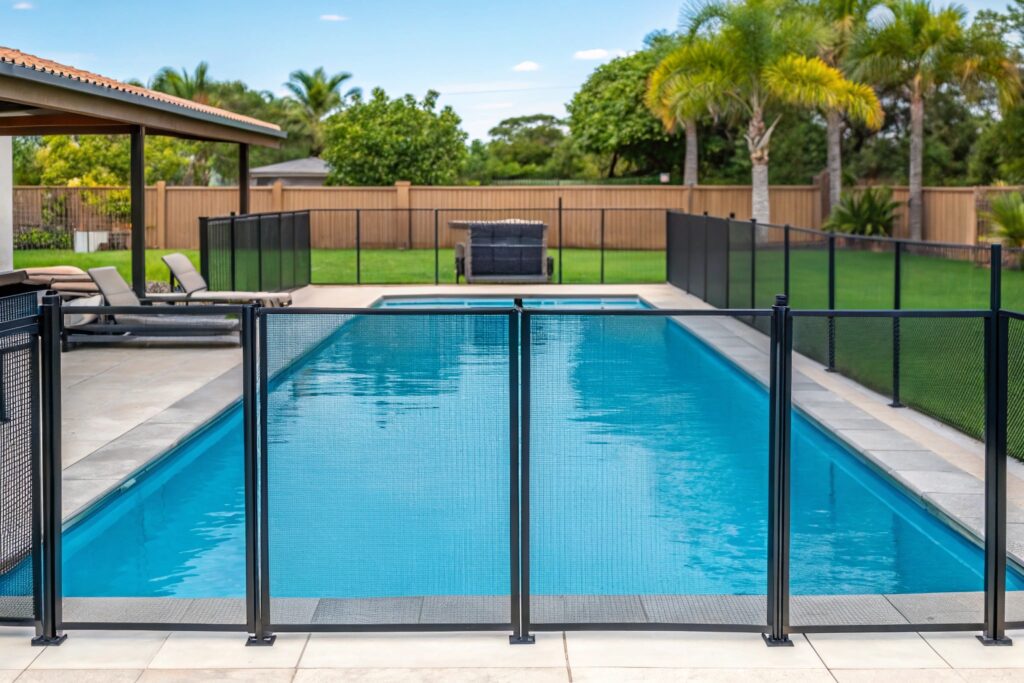
In-ground concrete pools don't appear on Subsidence Advisory NSW's exempt developments list, based on the April 2023 version. Several of the works around a pool do appear on it.
| Pool-area item | On the exempt list? | Guideline exception |
|---|---|---|
| In-ground concrete pool | Not listed | — |
| Timber or metal fencing, including pool fencing | Yes | Check the list for your guideline |
| Pergola | Yes | None (exempt under all guidelines) |
| Water feature | Yes | None (exempt under all guidelines) |
| Demolition | Yes | None (exempt under all guidelines) |
| Cabana | Yes | Not exempt under Guidelines 1 and 1A |
| Patio | Yes | Not exempt under Guidelines 1 and 1A |
| Deck or terrace | Yes | Not exempt under Guidelines 1 and 1A |
The Guideline 1 and 1A exception matters for whole-of-yard plans. On those properties, a cabana, patio or deck isn't covered by the list, so it needs Subsidence Advisory approval like the pool does.
"Exempt" here refers to Subsidence Advisory approval under the list only. It covers that one approval and nothing more.
If you're planning a custom pool and outdoor area together, it's worth mapping each item against your guideline early. When you're ready to take the next step, you can see how we plan concrete pool projects for Lambton properties.
When a Design Doesn't Fit the Guideline, and Confirming Your Own
Sometimes a preferred pool design won't match the guideline assigned to a property. In that case, the proposal may be assessed under Subsidence Advisory NSW's Merit Assessment Policy.
Before any of this applies, confirm which guideline your property has rather than assuming one. You can find it through the NSW Planning Portal's ePlanning Spatial Viewer. Guidelines are also subject to change, so it's worth checking the current version when you start planning.
A simple "before design" checklist:
- Find the guideline assigned to your property.
- Note whether your guideline requires an engineer's certification for a concrete pool.
- List the surrounding works you want, such as fencing, a pergola, a cabana or a deck.
With that information in hand, you're ready to start planning a concrete pool for your Lambton property with our team.